START WITH WHAT YOU NOTICED
Your snoring sounds loud. Start by recording when it happens.
SomniSense gives snoring a free, time-organized record with minute texture and available local audio. It does not turn loudness into an anatomical or medical conclusion.
Recorded loudness changes with phone distance, room noise, bedding, and microphone characteristics. Compare your own nights under similar conditions; do not map loudness to clinical severity.
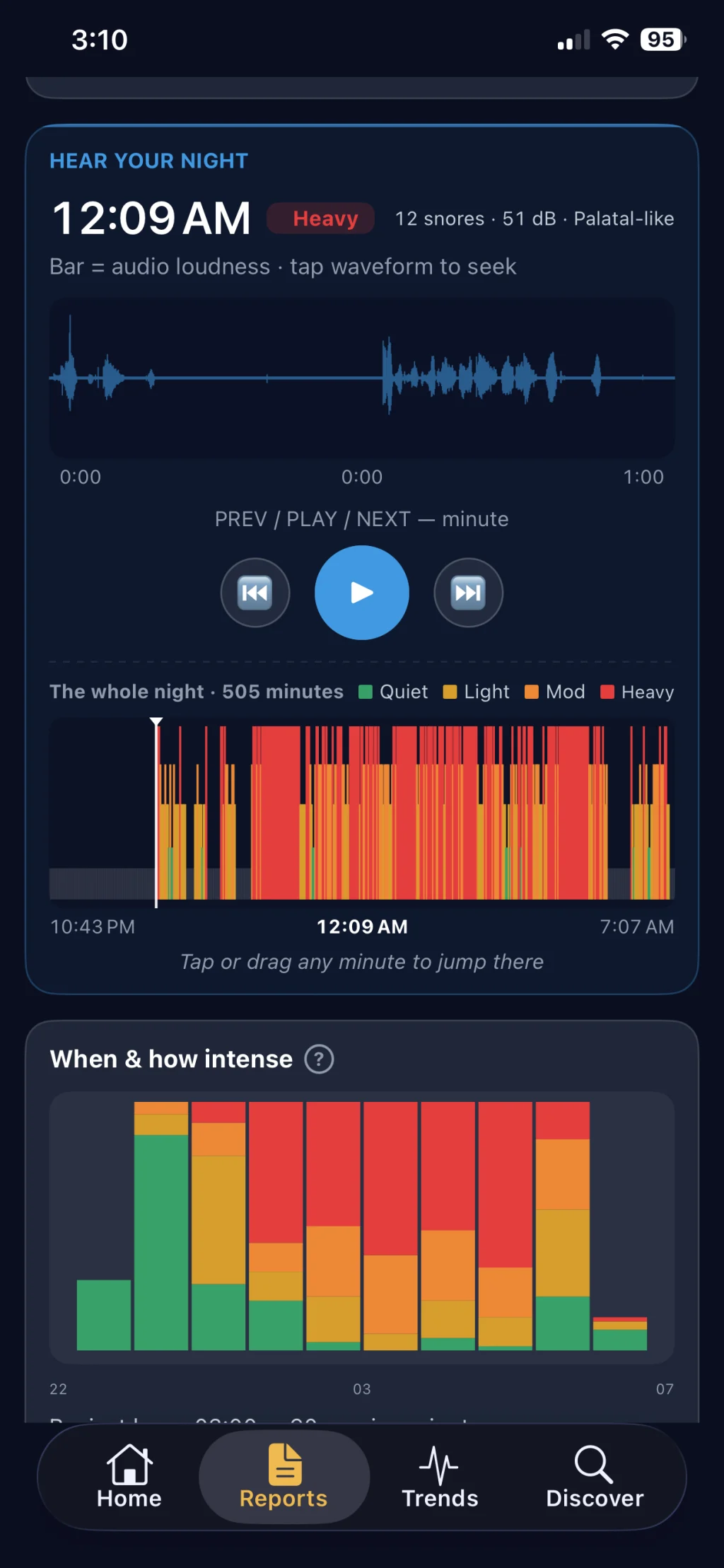
What the free snoring record shows
- When candidate snore-like sounds appeared
- SRI, a SomniSense-defined rate per estimated sleep hour
- Quiet/Light/Moderate/Heavy minute texture
- Room-relative loudness context
- Available local audio for selected moments
Can loud snoring be an OSA symptom?
Yes, frequent loud snoring is one symptom listed by NHLBI, especially when it appears alongside breathing that starts and stops, gasping, or significant daytime sleepiness. But not everyone who snores has sleep apnea, and loudness alone does not establish diagnosis or severity.
Keep snoring and breathing evidence separate
SomniSense tracks snore-like sounds and candidate breathing irregularities as separate evidence streams. A loud snoring night does not automatically have a higher BRI, and a quiet night cannot rule out candidate breathing patterns or a medical condition.
If you want deeper context, move from the whole night to the hour, selected minute, model-estimated candidate type and duration, marked waveform, whole-night position, and available local audio.
If a partner noticed it
Use the recording to replace an argument with a shared reference: when the sound appeared, how the night varied, and which audio is available. The recording can support a conversation; it cannot settle a diagnosis.
When to look beyond the app
Repeated witnessed pauses, gasping, persistent daytime sleepiness, or other concerns deserve appropriate professional evaluation. PSG and HSAT have medical testing authority because they measure signals a bedside microphone does not.
Read next
Common questions
Does louder snoring mean more severe sleep apnea?
Not necessarily. Loudness and clinical sleep-apnea severity are not interchangeable, and phone position and room acoustics affect recorded loudness.
Can SomniSense tell where the snoring comes from?
No. Phone audio cannot confirm airway anatomy. Any acoustic pattern label is a model estimate, not an anatomical finding.
Can a quiet night rule out a breathing problem?
No. A quiet recording, no candidate events, or a low product index cannot rule out a medical condition.
Keep several nights of observations in one clear report.
Longer-period structured reports organize candidate acoustic events, trends, tags, sample coverage, method, and limits. Save one for your own review or share it as background for a conversation. PDF reports are currently available in English.