FEATURE · SRI (SNORING RATE INDEX)
Start with the snoring you can hear and review.
Snoring is SomniSense's free, familiar entry point: see when it appeared, review minute-by-minute sound texture, and play available local audio. It is useful context, not a clinical severity measure.
Free includes candidate-event evidence, 5 audio plays per night, and a 7-day trend. Pro adds evidence continuity.
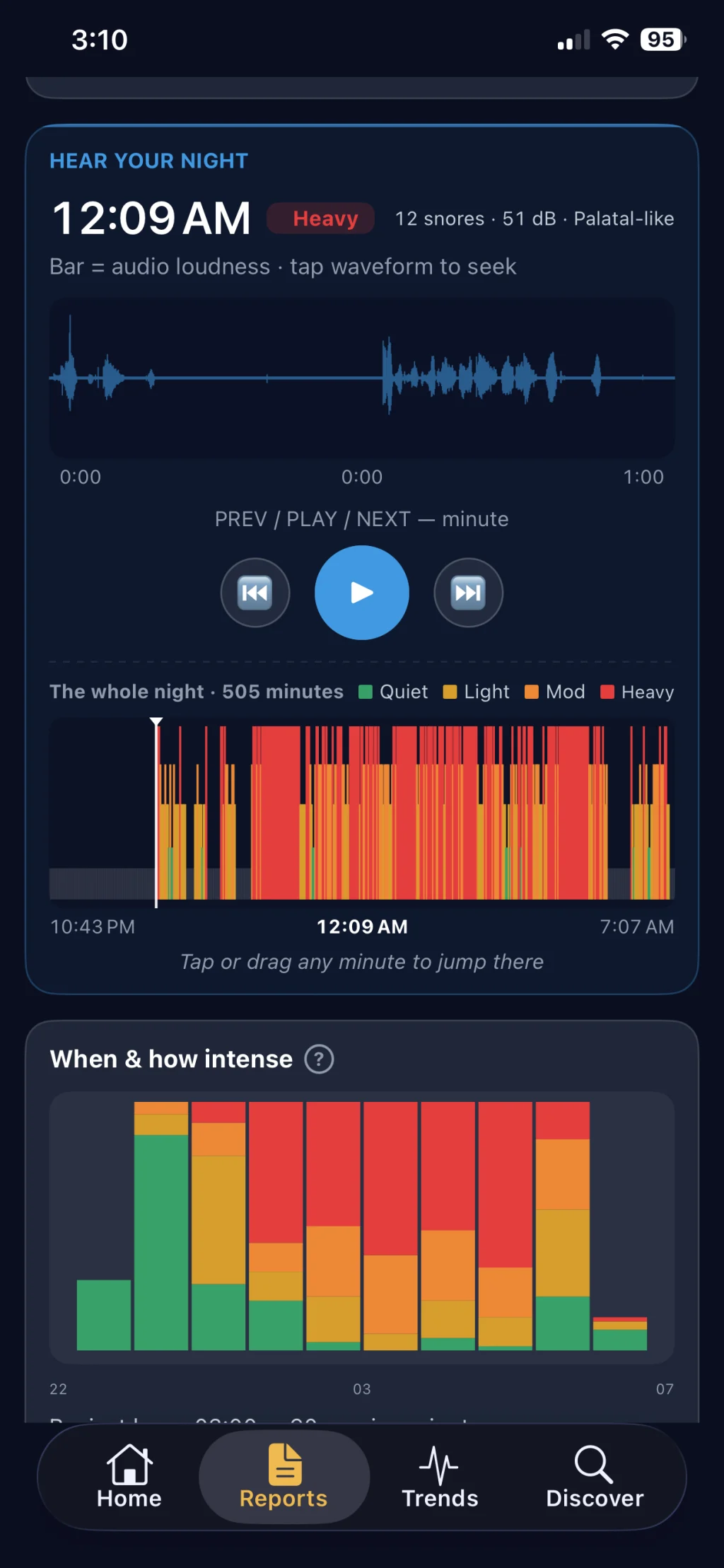
Snoring is the simplest place to start with SomniSense. Record for free, see when snore-like sounds appeared, review the minute-by-minute Quiet/Light/Moderate/Heavy texture, and play available local audio. Snoring evidence is useful on its own, but it does not reveal airway anatomy or medical severity.
What you can review after one night
- SRI — a SomniSense-defined rate of candidate snore-like sounds per estimated sleep hour.
- Whole-night timing — where snoring clustered rather than one isolated loudness peak.
- Minute-by-minute texture — Quiet, Light, Moderate, and Heavy product bands.
- Room-relative loudness — context that is affected by phone position and room acoustics.
- Available local audio — selected clips that let you hear what the microphone captured.
Why snoring stays separate from breathing evidence
A loud night is not automatically a night with more candidate breathing irregularities, and a quiet recording cannot rule them out. SomniSense keeps SRI and BRI separate so one familiar sound does not become a medical conclusion.
BRI is also a product-defined acoustic rate, not clinical AHI. Neither index should be mapped to clinical severity thresholds.
Use repeated nights for a fairer comparison
Phone distance, room noise, bedding, travel, and who else is in the room can change an acoustic recording. Keep the setup reasonably similar and look for patterns across nights instead of treating one result as a verdict.
If you tag a change—such as side sleeping, a pillow, or another routine—SomniSense can compare tagged and untagged nights once both groups have enough observations. That difference is an association, not proof that the change worked.
What the research number covers
The published snore benchmark reports 91.67% sensitivity and 89.01% precision for labeled 1-second snore segments across 80 paired PSG nights. It does not validate every production label, loudness reading, SRI value, bedroom, or personal trend.
What this feature does not claim
- It does not identify the anatomical source of a sound.
- It does not diagnose sleep apnea or another condition.
- It does not show oxygen, airflow, respiratory effort, EEG, or sleep stage.
- It does not recommend or validate a treatment.
Start with the familiar sound. If you want deeper context, continue to candidate breathing evidence, multi-night baselines, tagged-night comparisons, and structured reports.