COMPARISON · CLINICAL STUDY VS WELLNESS RECORD
A sleep study answers clinical questions. SomniSense keeps a different kind of record.
Polysomnography measures physiology for professional interpretation. SomniSense organizes candidate acoustic patterns from a phone microphone across ordinary nights; it does not reproduce or replace the study.
An in-lab polysomnography is the diagnostic gold standard: it measures multiple physiological channels and is interpreted professionally. SomniSense has a narrower job. It organizes model-estimated candidate acoustic patterns and selected audio from a phone microphone as a consumer wellness record. The published research used PSG-labeled data from 80 person-nights / 40 participants, but that does not make the app equivalent to PSG.
WHAT SOMNISENSE ADDS
Start tonight, then return to the candidate sound region — without confusing it with PSG.
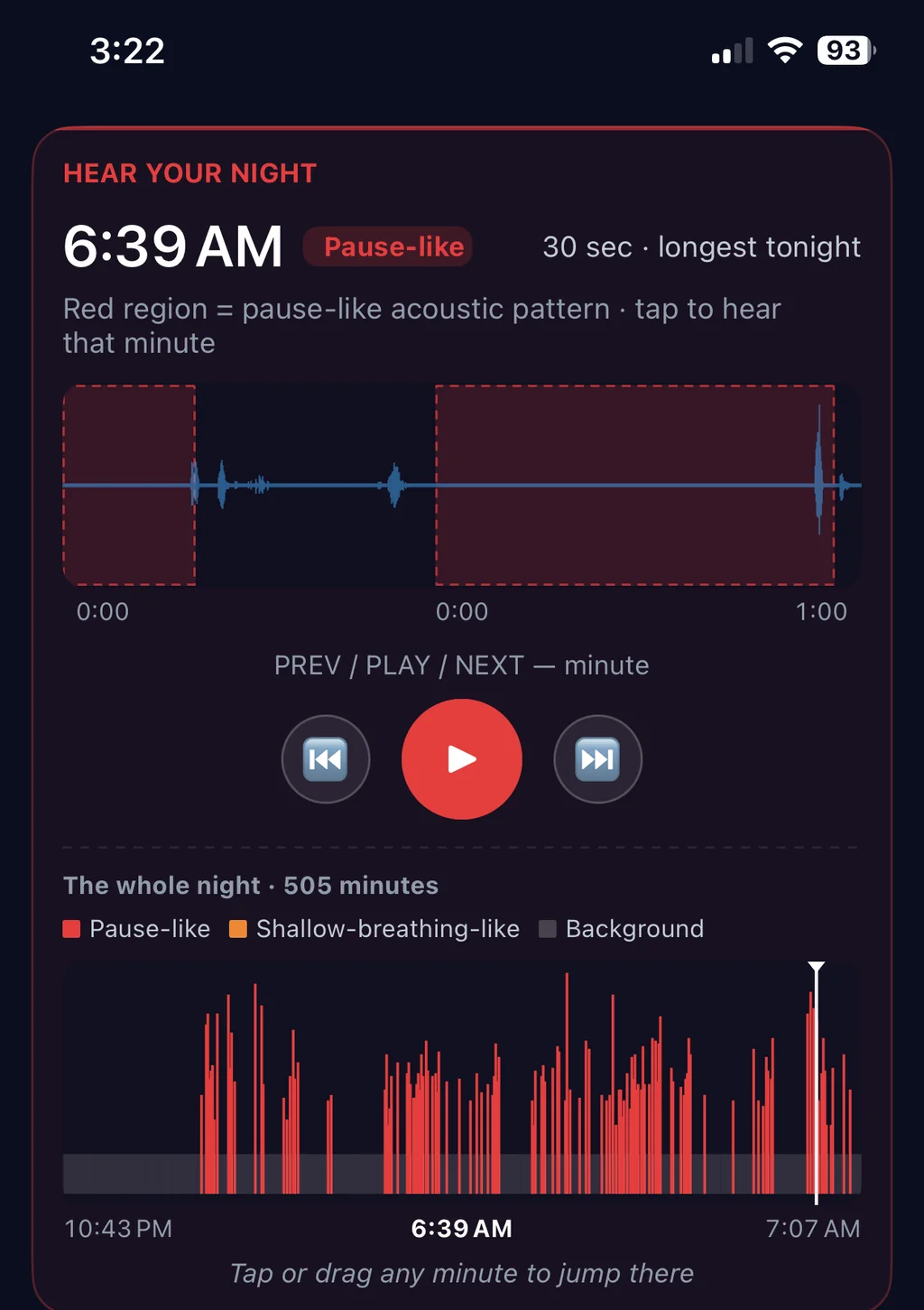
SomniSense needs no appointment, electrodes, or additional monitoring device. You choose which ordinary nights to record, then review the model-estimated candidate type, time, duration, marked waveform, available audio, and whole-night position. Repeated nights can form a baseline and structured report; none of those outputs replaces physiological measurement or professional interpretation.
- Candidate pause-like or shallow-breathing-like type, time, and model-estimated duration
- The marked waveform region and locally available audio for review
- Whole-night position, followed across nights in recent comparisons and structured reports
Phone audio is a limited wellness signal. Candidate regions are not clinical apnea events, AHI, oxygen measurements, airway-source findings, or a diagnosis.
The lab night you might already have had
An in-lab study uses multiple sensors and trained staff to record signals that a phone microphone cannot: sleep state, airflow, oxygen saturation, respiratory effort, heart activity, movement, and other clinical context.
It is the clinical reference for a reason. Professional interpretation can support diagnosis and treatment decisions; SomniSense cannot.
Cost, scheduling, setting, and the number of nights vary by care pathway. Those practical differences do not reduce the study's clinical role.
A study is appropriate when a diagnosis or treatment decision is needed. A consumer app can only keep a separate observational record between clinical encounters.
Ordinary nights outside the study
This is the gap I built SomniSense for.
A sleep lab answers clinical questions using physiological sensors and professional interpretation. SomniSense serves a different, observational job: it helps you keep a longer microphone-based record and compare nights carrying different tags. Those comparisons may show associations, but they do not measure whether an intervention worked.
SomniSense can add acoustic observations on nights outside a lab. The published 88.49% result covers labeled 200-second breathing-window classification; it does not validate every production output or make a personal trend equivalent to PSG. See the full methodology →
Where each one fits
On a small screen, swipe the table sideways to compare both paths.
| In-lab PSG | SomniSense | |
|---|---|---|
| What it provides | Clinical physiological measurement for professional interpretation | Candidate acoustic observations from ordinary nights |
| Setting | Sleep facility arranged through a clinical pathway | Your own bed |
| Sensors | EEG + EOG + EMG + SpO2 + airflow + chest band + leg + audio | Phone microphone |
| Access path | Clinician order, scheduling, payment or insurance, and lab or device availability vary | Start tonight with the supported phone already beside your bed |
| Recording cadence | Episodic and set by the clinical care pathway | User-controlled and repeatable across ordinary nights |
| Diagnostic authority | High — gold standard | None — wellness tool |
| Longer-period view | Depends on the prescribed clinical pathway | Recent 7-day and Pro 30/90-day wellness views |
| Selected audio review | Depends on the clinical report | Local audio around selected candidate regions |
| Personal routine tags | Not the purpose of the clinical study | Compare tagged and untagged app nights |
How the records can sit beside each other
The two records can sit beside each other only when their roles stay separate.
Step 1. If symptoms, witnessed pauses, gasping, persistent sleepiness, or safety concerns warrant it, speak with a clinician regardless of any app value.
Step 2. Complete the clinical testing recommended for you. The resulting measurements and professional interpretation are authoritative for diagnosis and care.
Step 3. If useful, share an optional SomniSense wellness summary as background. Your clinician decides whether and how to use it.
Step 4. If you begin clinician-guided treatment or another change, SomniSense can keep a separate acoustic record over time. It cannot determine whether treatment is effective.
What SomniSense is NOT trying to be
- Not a replacement for in-lab PSG. The lab is a different kind of measurement.
- Not a replacement for a qualified HSAT when one is medically indicated. Clinical home tests use physiological signals and an interpretation pathway that phone audio does not provide.
- Not a clinical diagnosis. BRI is a product-defined acoustic metric, not clinical AHI; it does not use AHI severity thresholds.
What it is: a low-friction way to keep a repeatable acoustic record across ordinary nights and prepare more specific questions. Symptoms and clinical concerns — not an app threshold — should determine whether you ask for a formal study.
Free basics stay available: core first-night candidate evidence, 5 audio plays per night, and a recent 7-day trend.
Read next
Common questions
- If I get an in-lab study, do I still need SomniSense?
- No. A clinician and the study answer the clinical question. SomniSense is optional if you want a separate microphone-based wellness record across ordinary nights.
- Can SomniSense replace a sleep study?
- No. PSG and qualified HSAT pathways measure clinical signals for professional interpretation. SomniSense is a wellness tool that organizes phone-acoustic observations; it does not diagnose.
- What if my SomniSense data and my lab study disagree?
- Use the clinical study and your clinician for diagnosis and care decisions. SomniSense outputs are not clinical measurements and should not be used to overrule or reinterpret the study.
- Should I show my SomniSense data to my sleep specialist?
- You can share it as a consumer wellness record if you think the longer pattern is useful. Your clinician decides whether and how to use it; it is not a clinical sleep report.
- How do cost and timing compare?
- Clinical-study cost, access, scheduling, and insurance steps vary by location and care pathway. SomniSense can start tonight with the phone you already own, but that access advantage does not give it clinical authority.