Understanding BRI — and why it is not AHI.
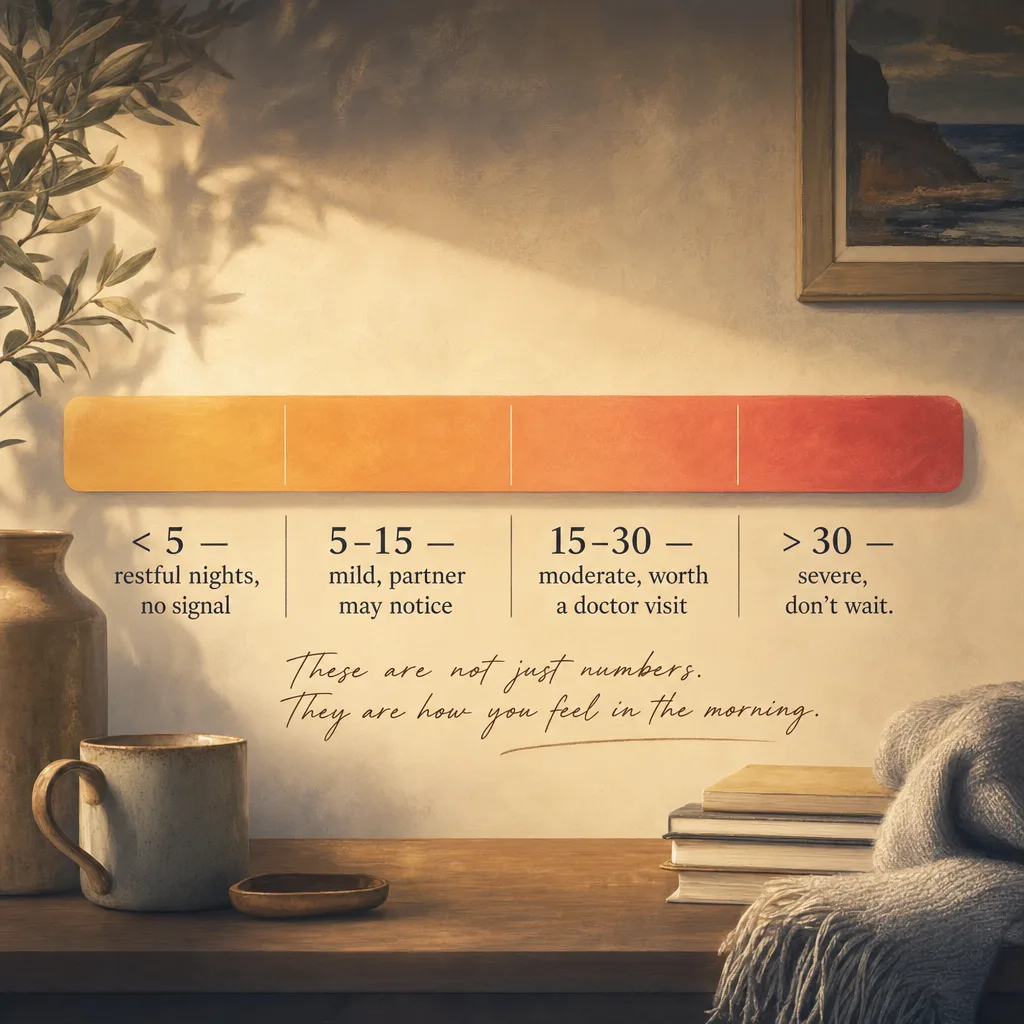
SomniSense reports a product-defined metric called BRI — Breathing Irregularity Index. It summarizes candidate acoustic patterns per estimated sleep hour. BRI is not clinical AHI, and AHI severity thresholds should not be applied to it.

What BRI is
BRI is a rate of candidate breathing-irregularity patterns produced by SomniSense acoustic analysis. The app uses two product labels:
- Pause-like pattern — an acoustic interval that resembles a sustained interruption in the recorded breathing pattern.
- Shallow-breathing-like pattern — a quieter or reduced acoustic pattern marked for review.
The app divides candidate events by estimated sleep hours to produce BRI. Phone audio does not directly measure airflow, oxygen, respiratory effort, arousal, or sleep stage.
What AHI is
AHI = Apnea-Hypopnea Index, a clinical metric derived from medically defined events using appropriate sleep-testing signals and scoring criteria:
- You're in a sleep lab (or wearing an HSAT device at home)
- You have a chest belt measuring respiratory effort
- You have a finger pulse oximeter measuring blood oxygen
- You may have nasal/oral airflow sensors directly measuring breath volume
- An AASM-trained sleep technician scores each event with full clinical criteria
Clinical AHI thresholds belong to that clinical measurement and should not be transferred to BRI.
Why BRI isn't called AHI
Three reasons, all of them important to me:
1. The measurement source is different
AHI is derived from multi-channel clinical signals that can include airflow and oxygen. BRI is produced from a microphone without direct airflow, oxygen, respiratory-effort, arousal, or sleep-stage measurement. The model marks candidate acoustic patterns; it does not confirm clinical events or distinguish obstructive from central apnea.
Calling our acoustic-only metric "AHI" would imply we're measuring it the same way a clinic measures it. We're not. Naming it BRI is a way of being honest about that.
2. The published benchmark evaluates a different unit
The published production result evaluates classification of labeled 200-second breathing windows. It does not independently validate every event boundary, duration, nightly BRI value, or clinical severity category.
3. We're a wellness tool, not a medical device
AHI is a clinical metric used within medical assessment. SomniSense does not diagnose anything. Calling BRI “AHI” would imply clinical equivalence that the product and evidence do not support.
How to read your BRI
Use BRI to compare your own nights under reasonably similar recording conditions:
- Look for repeated patterns, not a diagnosis from one night.
- Keep the phone placement and room conditions comparable when possible.
- Do not use AHI severity labels for BRI values.
- Seek professional evaluation for symptoms or concerns regardless of the app's number.
What to bring to your doctor
If you're going to a sleep specialist with SomniSense data, the most useful framing is:
- "I've been tracking with a smartphone app called SomniSense."
- "It reports a product-defined acoustic metric called BRI; I understand it is not AHI."
- "My BRI averages around X over [time period] of nights."
- "Here's a structured wellness PDF showing the product observations and limits."
Your clinician decides whether the wellness summary is useful. Appropriate medical testing, history, and professional judgment remain the basis for diagnosis and treatment.
One more nuance — clustering matters
A timeline and a single average describe different aspects of the app's own observations:
Two sessions can have the same BRI while their candidate regions appear at different times. That difference may be useful for reviewing the recordings, but BRI has no clinical “normal” band and the app cannot infer sleep stage or cognitive impact from microphone audio alone.
Average BRI doesn't tell you that. The Every-Event Timeline does. More on the timeline view here.
Read next
If you'd rather see your own night than read about someone else's —
It's free on both stores. Put the phone on the nightstand tonight; the report is there when you wake up.
Free basics stay available: core first-night candidate evidence, 5 audio plays per night, and a recent 7-day trend.